Business automation, without burning a quarter learning the wrong tool.
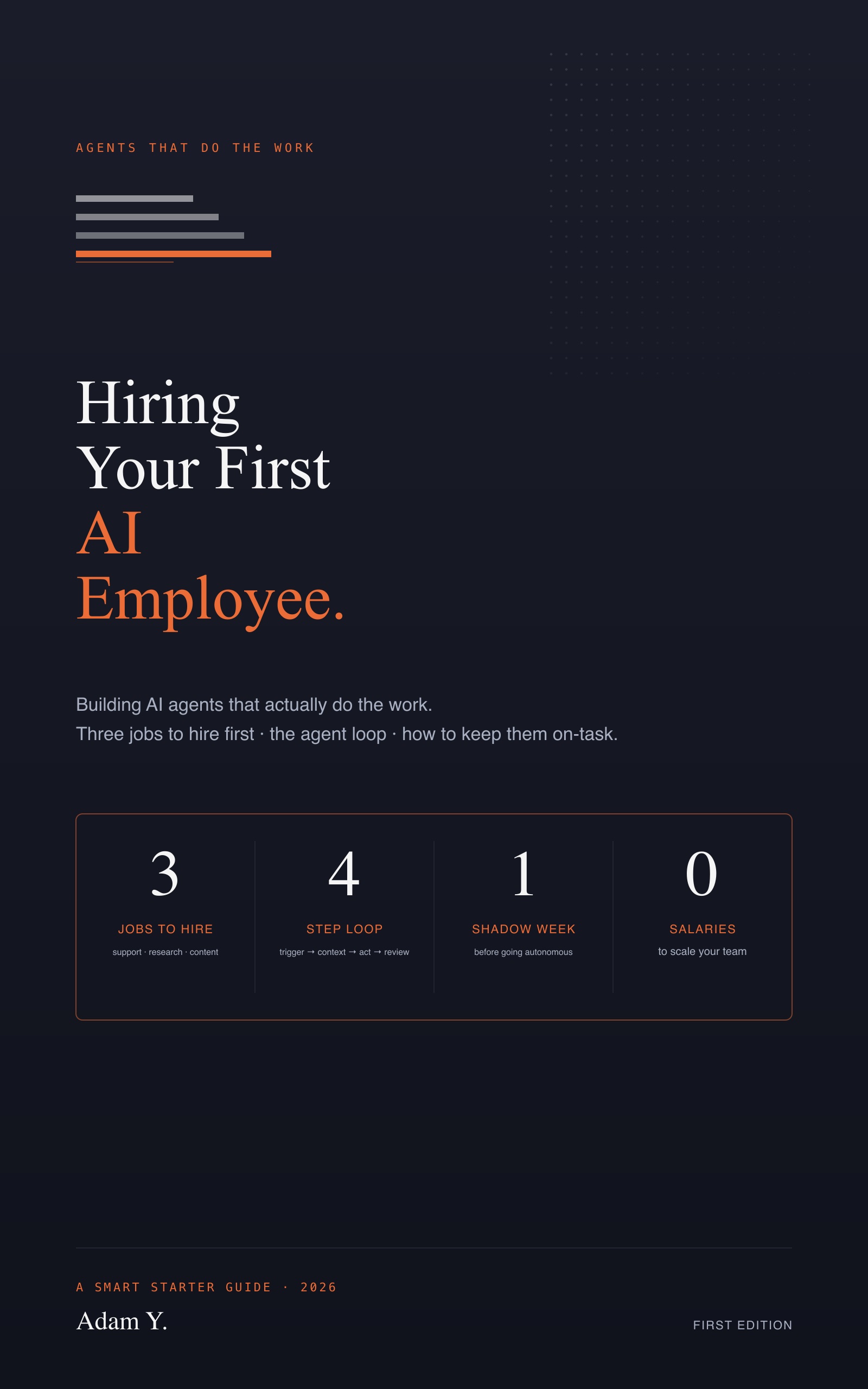
Building AI agents that actually do the work. Three jobs to hire AI for first, the agent loop, and how to monitor + train an agent without losing control.
PDF + online edition · 10 chapters · ~20 min reading time · Lifetime updates
A complete framework for picking the right automation level — and the implementation guides to ship it.
The four-level framework
Native integrations, Zapier-style task tools, Make/Workato visual workflows, and self-hosted N8N — when each one is the right answer.
Decision tree + cost math
A six-question decision tree that maps your situation to a level, plus the cost calculations that show when each tier stops being worth it.
End-to-end blueprints
Full walkthroughs for lead capture, data backups, content distribution, and customer onboarding — implementable at any of the four levels.
10 chapters · 4,780 words
- 01 What an AI Agent Is — and How It Differs From a Chatbot 2 min
- 02 Chapter 1: The Three Jobs Worth Hiring AI For First 2 min
- 03 Chapter 2: Building Your Customer Support Agent 4 min
- 04 Chapter 3: Building Your Research and Briefing Agent 3 min
- 05 Chapter 4: Building Your Content Pipeline Agent 3 min
- 06 Chapter 5: The Handoff Protocol — When AI Escalates to You 1 min
- 07 Chapter 6: Training Your Agent 1 min
- 08 Chapter 7: Monitoring and Quality Control 1 min
- 09 Chapter 8: Ethics and Transparency 2 min
- 10 Chapter 9: Your AI Team in Year Two 2 min
Before you buy
Do I need technical skills to build AI agents?
Some — yes. The first 'agent' described in the guide is built in Make.com with a few HTTP calls to Claude/OpenAI. No code, but you'll touch API keys and webhook URLs. If you can set up a Zapier workflow, you can build the agents in this guide.
Is this just ChatGPT prompts?
No. Prompts are part of it but the focus is on the operating loop — how an agent receives work, takes action, logs the result, and gets supervised. The patterns here are the difference between an AI 'helper' and an AI 'employee' that actually closes work.
Are AI agents safe to deploy in my business?
Supervised agents — yes. The 'AI drafts, human approves' pattern is production-ready and explicit in the guide. Fully autonomous agents that send customer emails without review are not recommended yet, and the guide tells you exactly why and where to draw the line.
What can a first AI agent actually do?
The three jobs covered: (1) customer support triage with drafted responses, (2) weekly competitive intelligence briefings, (3) content pipeline (brief → draft → platform variations). Each saves 3–10 hours per week and is implementable in a weekend.
Stop researching. Start automating.
One careful read saves a quarter of trial-and-error.
PDF + online edition with lifetime updates.