Business automation, without burning a quarter learning the wrong tool.
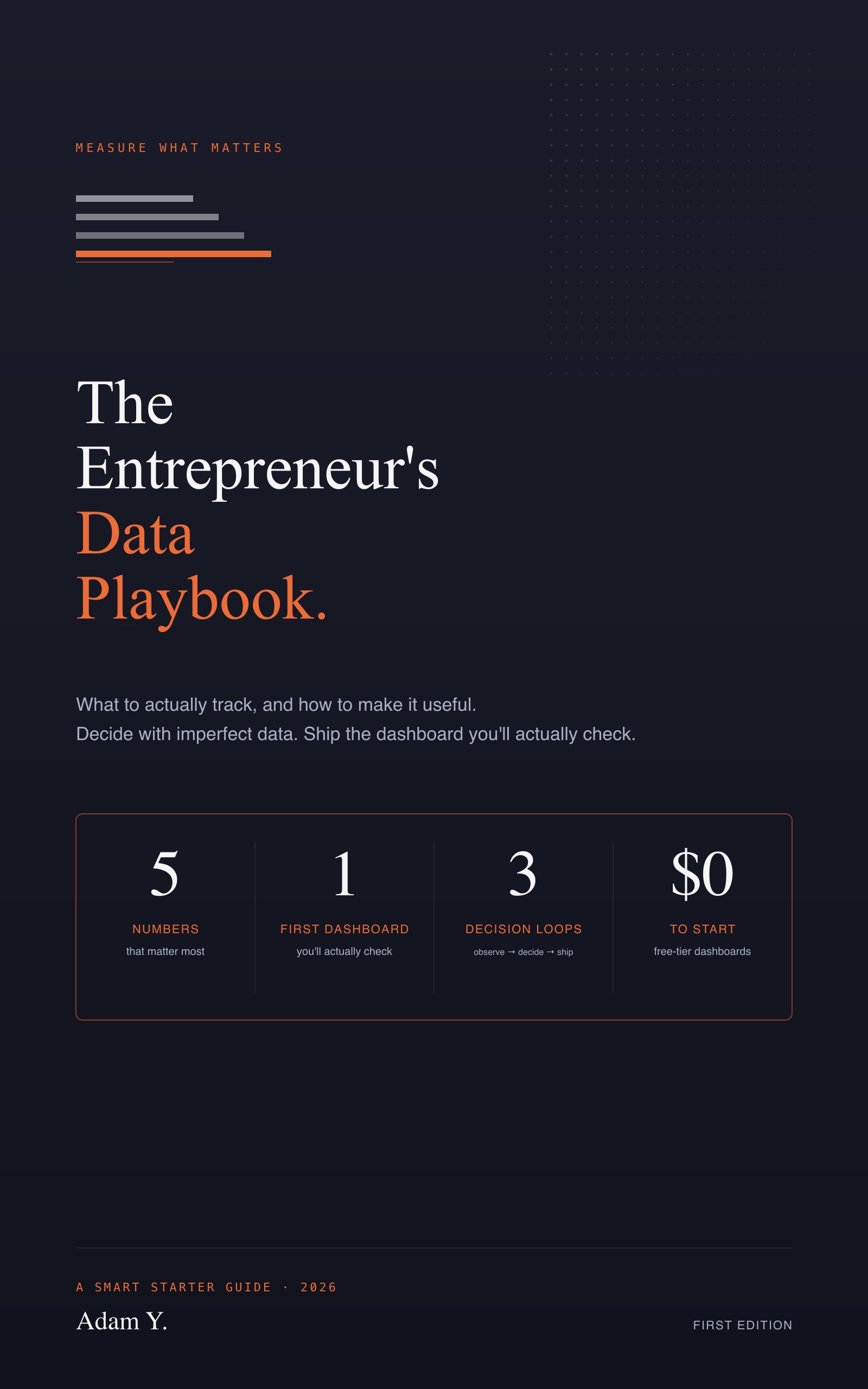
What to actually track, and how to make it useful. The five numbers that matter, your first dashboard, and how to make decisions with imperfect data.
PDF + online edition · 11 chapters · ~20 min reading time · Lifetime updates
A complete framework for picking the right automation level — and the implementation guides to ship it.
The four-level framework
Native integrations, Zapier-style task tools, Make/Workato visual workflows, and self-hosted N8N — when each one is the right answer.
Decision tree + cost math
A six-question decision tree that maps your situation to a level, plus the cost calculations that show when each tier stops being worth it.
End-to-end blueprints
Full walkthroughs for lead capture, data backups, content distribution, and customer onboarding — implementable at any of the four levels.
11 chapters · 4,445 words
- 01 Why Most Entrepreneurs Are Flying Blind 1 min
- 02 Chapter 1: The Only 5 Numbers That Matter Early On 3 min
- 03 Chapter 2: Your First Dashboard 2 min
- 04 Chapter 3: Revenue Metrics That Predict Growth 2 min
- 05 Chapter 4: Understanding Your Customer Journey With Data 2 min
- 06 Chapter 5: Marketing Data — What to Track, What to Ignore 2 min
- 07 Chapter 6: Setting Up Automated Reports 2 min
- 08 Chapter 7: Operational Data 2 min
- 09 Chapter 8: Making Decisions With Imperfect Data 2 min
- 10 Chapter 9: When to Graduate to Real Analytics Tools 1 min
- 11 Your Data Action Plan 1 min
Before you buy
Do I need data tools or analytics knowledge first?
No. The guide assumes a Stripe account, a CRM (or spreadsheet), and Google Analytics — that's it. The first dashboard is built in a Google Sheet in under an hour. Tool upgrades are explicit and only when the spreadsheet hits a real ceiling.
Is this for solo founders or teams?
Both. The five-number framework is the same. Solo founders use it to know if the business is healthy. Teams use it to align on what to optimize. The team-specific patterns (weekly business review, dashboard sharing, ownership of metrics) are covered explicitly.
Will this work if my data is messy?
Yes — it's designed for messy data, because most early-stage businesses have it. The guide explicitly covers how to make decisions with incomplete information, when 'roughly right' beats 'precisely wrong', and the patterns for cleaning data over time without blocking decisions.
How is this different from a generic analytics course?
Analytics courses teach tools (GA4, Looker, SQL). This teaches what to measure, how often, and how to act on it. It's about the operator's relationship to numbers, not the analyst's tooling. If you're trying to run a business by the numbers, this is the layer above the tools.
Stop researching. Start automating.
One careful read saves a quarter of trial-and-error.
PDF + online edition with lifetime updates.